
For the woman who’s tired of pretending she has it all figured out.
You’ve been sold a lie.
Not deliberately, maybe. But a lie nonetheless.
The lie says: Get good enough, disciplined enough, spiritual enough, and you’ll reach a point where life is smooth. Where you don’t struggle. Where the anxiety quiets, the relationships flow, the business runs itself, and you wake up feeling whole.
You’ve chased that version of yourself for decades.
You’ve read the books, taken the courses, tried the systems. You’ve white-knuckled your way through discipline. You’ve prayed for breakthrough. You’ve worked harder, loved deeper, sacrificed more. And somewhere along the way, you started to believe that if you just tried harder, you’d finally arrive at the version of yourself that doesn’t break.
That doesn’t struggle. That doesn’t need help.
But here’s what nobody tells you: That version of yourself doesn’t exist. And thank God for that.
Because the path to your Next Level Human isn’t found in achieving perfection. It’s found in surrendering it.
It’s found in your brokenness.
The Cult of Flawlessness
We live in a culture obsessed with the appearance of wholeness.
On Instagram, women curate the highlight reel. In Facebook groups, they share their wins. In board meetings, they project confidence. In family texts, they manage the narrative. The unspoken rule is: Show strength. Hide struggle. Never let them see you sweat.
And if you’re a high-performing woman, you learned this rule early and learned it well.
You learned that vulnerability is weakness. That asking for help is failure. That admitting you don’t know is career suicide. You learned that your value lives in your competence, your reliability, your unwavering capability.
So you built a life around never breaking.
You became the one people could count on. The one with answers. The one who didn’t need rescuing. And for a while, that worked. It got you promotions, respect, a functional life. But it also got you:
- Relationships where no one really knows you.
- A business built on your personal capacity (which is finite).
- A nervous system stuck in high alert, because perfection is exhausting.
- A deep, unnamed loneliness—the kind that comes from never letting anyone see the real you.
The lie promised that flawlessness would set you free. Instead, it imprisoned you.
The Crack is Where the Light Gets In
There’s a famous Leonard Cohen lyric: “There is a crack in everything / That’s how the light gets in.”
This is not poetry. This is theology.
Every major spiritual tradition understands something that our culture denies: Your brokenness is the gateway to transformation.
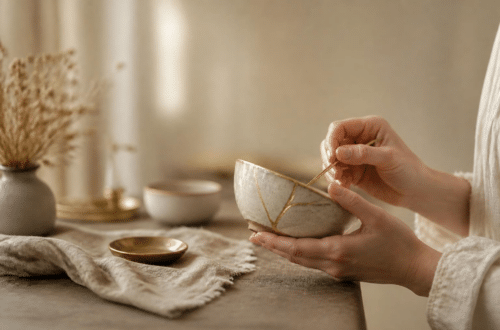
The Christian tradition calls it kenosis: the pouring out of self. The Japanese art of kintsugi repairs broken pottery with gold, making the breaks more beautiful than the original. The 12-step program is built entirely on the premise that you cannot recover until you admit you’re broken. Indigenous wisdom says that the wound is where the medicine enters.
They’re all saying the same thing: The crack is not the problem. The crack is the solution.
But we’ve been taught the opposite. We’ve been taught that brokenness is something to hide, to overcome, to transcend. We’ve been sold the fantasy that enlightenment looks like unshakeable certainty, unwavering confidence, a life free from pain.
So we spend our energy sealing up the cracks. We plaster over the vulnerability. We perform wholeness.
And we miss the entire point.
What Your Brokenness Actually Reveals
Here’s what happens when you stop pretending and start admitting.
When you admit that you’re exhausted, you stop burning yourself out trying to hide it. Your nervous system gets a chance to regulate.
When you admit that you don’t have all the answers, you open yourself to learning. You become teachable. You become wise instead of just knowledgeable.
When you admit that your relationships are transactional, you become available to genuine connection. People feel the shift. They trust you differently. They show up differently.
When you admit that you’re afraid—of failure, of irrelevance, of being left behind, of not being enough—you move from a nervous system stuck in survival mode to one that can actually rest.
When you admit that you need help, you become part of a community. You stop carrying everything alone. You discover that vulnerability is actually the strongest thing you have.
This is what brokenness reveals: Your humanity is not a flaw. It’s your greatest asset.
The high-performing woman who has all the answers? People respect her from a distance.
The high-performing woman who admits she’s struggling and asks for help? People trust her. They follow her. They’re moved by her. Because she’s real.
And realness is magnetic.
The Difference Between Breaking Down and Breaking Open
There’s an important distinction here, because this isn’t a post about toxic positivity or pretending that struggle is fun.
Struggle is hard. Brokenness is painful. When your life falls apart—when your marriage fractures, your business struggles, your health fails, your identity cracks—that’s not a spiritual experience to celebrate. That’s a genuine crisis.
But here’s what we get wrong: There’s a difference between breaking down and breaking open.
Breaking down is what happens when you hit the wall while running on the old operating system. Your nervous system is so dysregulated that you can’t function. Your relationships are so damaged that you’re isolated. Your identity is so fragile that any setback shatters it. This is what happens when you spend decades denying your humanity.
Breaking open is what happens when you choose to surrender before you’re forced to. When you consciously release the need to be perfect. When you admit—before crisis forces you to—that you’re human, that you need help, that your worth isn’t tied to your output.
Breaking open is intentional. It’s vulnerable, yes. But it’s not a breakdown. It’s a breakthrough.
And the path from breaking down to breaking open? That’s where transformation lives.
How God Uses Your Cracks
If you’re a woman of faith—whether Christian, spiritual, or simply open to something larger than yourself—you’ve probably encountered the idea that God works through weakness.
Paul wrote: “My grace is sufficient for you, for my power is made perfect in weakness.”
This is not poetic sentiment. This is practical spiritual instruction.
When you’re relying on your own strength, your own strategy, your own willpower, you’re operating in a closed system. You’re limited to what you can figure out, control, and force. And that system has gotten you to burnout.
But when you surrender—when you admit that your current identity cannot solve this problem, that you need help, that you’re willing to be changed—you open yourself to something larger. To grace. To guidance. To the kind of transformation that no amount of self-discipline could ever create.
Your cracks are where God gets in.
Not to judge you for being broken. Not to shame you for struggling. But to remake you. To use your pain to build compassion. To use your failure to build wisdom. To use your vulnerability to build authentic leadership.
This is what the Franciscan concept of stewardship teaches us. Saint Francis didn’t build his legacy by being perfect. He built it by surrendering everything—his wealth, his reputation, his safety—and trusting that in the emptiness, something larger would fill the space.
Your brokenness works the same way.
When you stop trying to be the woman who has it all figured out, you become available to being the woman who has figured out how to not have to have it all figured out. You become available to presence, to wisdom, to genuine leadership.
You become a steward instead of a controller.
The Three Levels of Brokenness
This is where the real transformation begins. Because brokenness isn’t a one-time event. It’s a process of progressive surrender.
Level 1: The Breaking Point
You hit the wall. Burnout is no longer a word; it’s your life. Your relationships are cracking. Your health is failing. You can’t keep going the way you’ve been going. This is where you finally admit: I’m broken. My current system doesn’t work. I need help.
This is painful. And it’s also the doorway.
Level 2: The Breaking Open
You start to do the work. You rewire your nervous system. You practice the Steward’s Pause. You begin to release the identity that’s been running you. You admit your needs to other people. You ask for help. You let people see you struggle.
This is vulnerable. And it’s also where healing accelerates.
You start to realize that your brokenness isn’t your enemy. It’s your greatest teacher. Your relationships deepen because you’re real now. Your business actually grows because you’re not carrying it on your back alone. Your nervous system begins to regulate because you’ve stopped fighting yourself.
Level 3: The Integration
You’ve woven your brokenness into your wisdom. You don’t pretend to be whole. You are whole—not because you’re perfect, but because you’ve integrated your humanity. Your cracks have been filled with gold (to use the kintsugi metaphor). They’re more beautiful now than the original.
You lead from presence, not performance. You connect from authenticity, not strategy. You serve from abundance, not desperation. You’ve become the woman who admits she doesn’t have all the answers, and that’s exactly why people trust her leadership.
This is the Next Level Human.
And it was only possible because you surrendered perfection.
What Your Brokenness Makes Possible
Here’s what I want you to understand: Your brokenness isn’t holding you back from your potential. Your brokenness is the raw material of your potential.
The woman who’s never struggled can’t help someone else through struggle. She can offer advice but not presence. She can offer strategy but not compassion. She can offer information but not transformation.
But the woman who’s been broken, who’s admitted it, who’s done the work to integrate it? That woman can change lives. Because she knows the path. She’s walked it. She can recognize the signs of someone hitting the wall because she’s been there.
Your brokenness makes you:
- Compassionate: You can’t judge others for struggling because you’ve struggled. You can’t demand perfection because you’ve failed. You become someone who meets people where they are.
- Wise: Wisdom isn’t knowledge. Wisdom is understanding what matters and what doesn’t. It’s knowing the difference between the noise and the signal. And wisdom only comes through experience, including painful experience.
- Authentic: When you stop pretending, people feel it. They relax. They become real too. You create spaces where transformation is actually possible because people don’t have to perform.
- Resilient: You’ve been broken, and you’re still here. You’ve failed and you’re still moving forward. You know—not as theory but as lived experience—that you can survive hard things.
- Connected: You’re no longer performing for an audience. You’re showing up as yourself. And that’s when real connection happens. That’s when community forms. That’s when you’re no longer carrying everything alone.
This is the gift of your brokenness.
The Invitation: Stop Sealing Your Cracks
If you’re reading this and you’re tired of pretending—tired of being the woman who has it all together, tired of hiding your struggle, tired of the exhaustion of performance—this is your permission slip.
You don’t have to be perfect.
You don’t have to have it all figured out.
You don’t have to be unshakeable.
You can be broken. And broken is not the same as damaged beyond repair. Broken is the beginning of something new.
The cracks in your life aren’t failures. They’re invitations. They’re where the light gets in. They’re where God gets in. They’re where transformation begins.
The path to your next level human runs directly through your brokenness.
Not around it. Through it.
And on the other side of that surrender, you’ll find something you didn’t expect: not a perfect life but a real one. Not an unshakeable identity but an integrated one. Not the woman who has it all together but the woman who knows how to let it fall apart and trust that something larger will catch her.
That woman is already inside you.
She’s just waiting for you to stop sealing up your cracks.
How The Steward Within Supports Your Integration
The Steward Within program is built on the understanding that transformation requires you to move through your brokenness not around it.
Using the wisdom of 12-step recovery (which is built entirely on admitting what’s broken), combined with the identity work of the Human Architect approach, we guide you through:
- Rewriting your story so brokenness becomes part of your wisdom not proof of your failure.
- Rewiring your nervous system so vulnerability feels safe instead of dangerous.
- Retraining your behaviors so you can show up authentically in your business, your relationships, and your life.
This isn’t about achieving perfection. It’s about achieving integration. About becoming the woman who knows herself, including the broken parts, and leads from that wholeness.
Which level feels right for you?
- Silver: Learn at your own pace with curriculum, community, and breathwork tools.
- Gold: Accelerate through live coaching clinics and real-time practice.
- Platinum: One-on-one customized support for deep nervous system rewiring.
Ready to stop performing and start living?
Start with our free 7-Day Micro-Course or Schedule Your Onboarding Conversation to discover which level is right for you.
Your brokenness is not your enemy. It’s your gateway.